
10 Best Cities to Visit in France
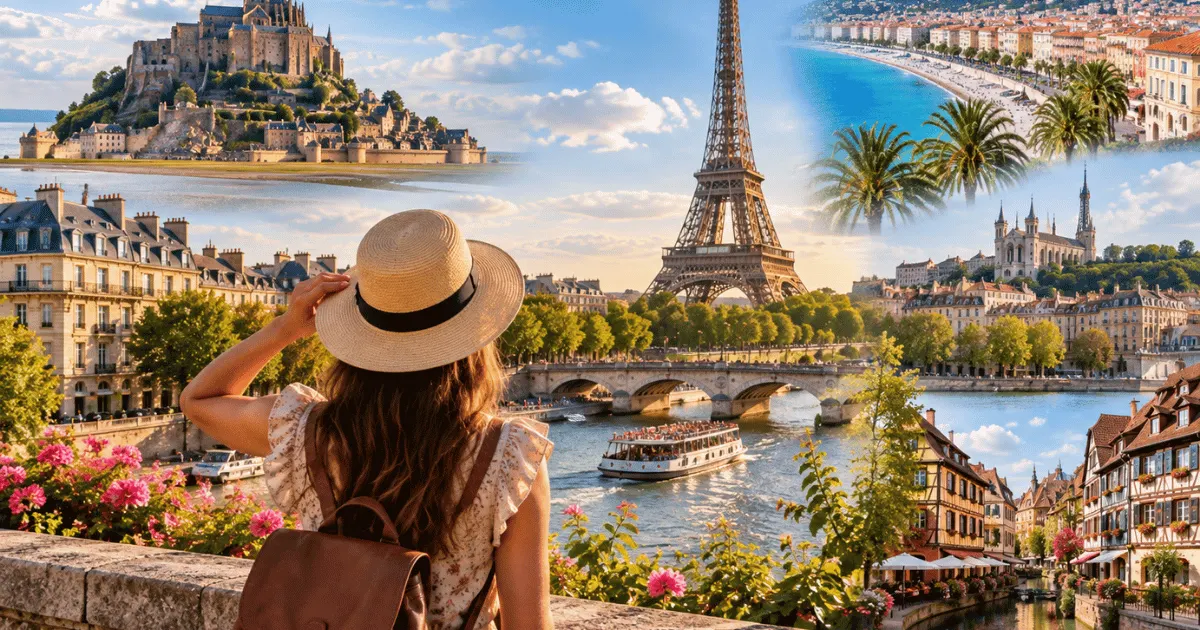
France is much more than Paris. From the French Riviera and Mediterranean coast to historic old towns, major food regions, wine country, and lively southern cities, the best cities to visit in France offer very different travel experiences.
For a first trip, Paris is an obvious starting point, but Nice, Lyon, Bordeaux, Marseille, Strasbourg, Toulouse, Lille, Aix-en-Provence, and Montpellier each reveal a different side of the country. France’s official tourism platform highlights a broad selection of major French city destinations, with experiences ranging from culture and food to coastal escapes and historic neighborhoods. France.fr
The right choice depends on what you want from your trip. Some cities are ideal for museums and landmarks, others for food, beaches, wine, history, or a slower southern pace. Your ideal base also depends on how many days you have and whether you plan to add day trips.
Key Takeaways
- Paris is the easiest all-round choice for a first trip, while Nice adds the French Riviera and Mediterranean coast.
- Lyon is especially well suited to food and history, Bordeaux combines architecture with wine country, and Strasbourg offers a compact historic experience.
- Marseille and Montpellier work well for coastal itineraries, while Toulouse, Lille, and Aix-en-Provence offer distinctive regional character.
- For a first week in France, two cities is usually easier to enjoy than trying to cover three or four.
Best Cities to Visit in France at a Glance
The table below gives you a quick way to compare the cities before deciding where to stay. The suggested trip lengths are planning ranges rather than fixed rules, and your ideal stay will depend on your interests and day-trip plans.
| City | Best For | Ideal Stay | Convenient Area to Stay |
|---|---|---|---|
| Paris | First-time visitors, landmarks, museums, culture | 3–5 days | Central Paris / Left Bank |
| Nice | French Riviera, coast, couples, sunshine | 3–4 days | Vieux-Nice / Carré d’Or |
| Lyon | Food, history, architecture, culture | 2–3 days | Presqu’île / Vieux Lyon |
| Bordeaux | Wine, architecture, gastronomy | 2–3 days | Historic center / Chartrons |
| Marseille | Coast, history, outdoor experiences | 2–3 days | Vieux-Port area |
| Strasbourg | History, Alsace, architecture, short breaks | 2 days | Grande Île / Petite France |
| Toulouse | Southern culture, food, relaxed city breaks | 2–3 days | Capitole / Carmes |
| Lille | Weekend trips, architecture, food | 2 days | Vieux Lille / city center |
| Aix-en-Provence | Provence, art, markets, slow travel | 2 days | Historic center |
| Montpellier | Mediterranean lifestyle, culture, nearby beaches | 2–3 days | Écusson / city center |
A useful rule is to choose the city that matches the experience you want instead of trying to fit every famous destination into one itinerary. A smaller number of well-chosen bases usually gives you more time for neighborhoods, restaurants, museums, and local experiences.
10 Best Cities to Visit in France
This is a practical editorial selection rather than an official national ranking. The goal is to highlight ten cities that add genuinely different experiences to a France itinerary.
1. Paris — France’s Iconic Capital
Why visit Paris
Paris is the most straightforward city in France for a first visit because so much of the country’s cultural identity is concentrated here. The Eiffel Tower, Louvre Museum, Notre-Dame, Arc de Triomphe, Seine River, Montmartre, Latin Quarter, and historic boulevards give you a long list of major sights, but the city is just as enjoyable when you slow down between them.
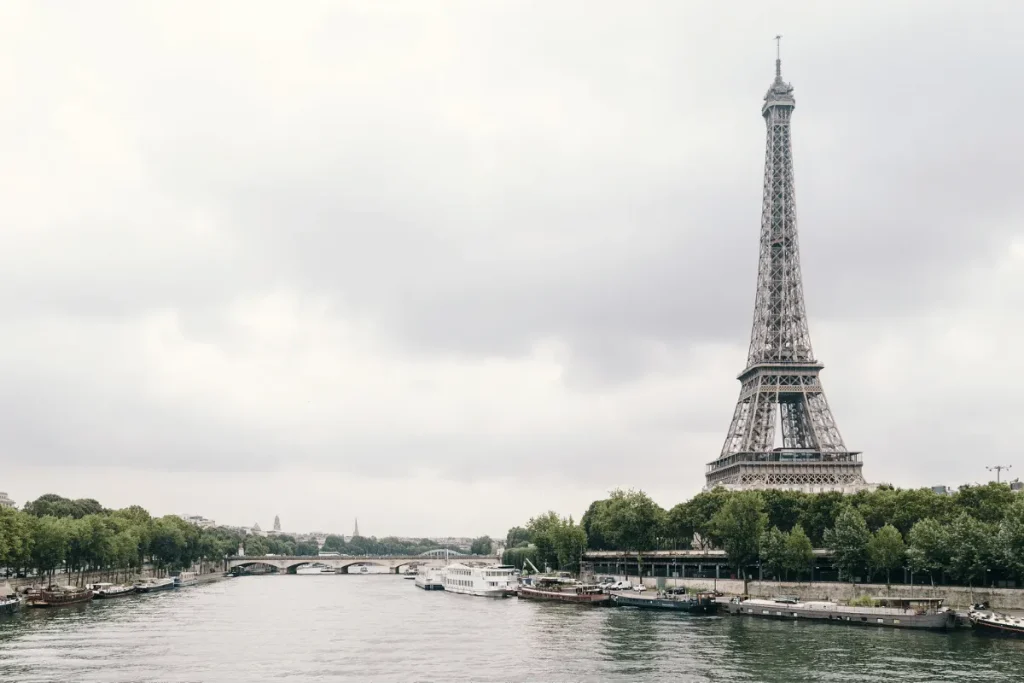
A memorable Paris day does not have to mean moving from one attraction to the next. You could visit a museum in the morning, stop for lunch at a café, walk beside the Seine in the afternoon, and spend the evening exploring a different neighborhood. France.fr also highlights the city’s museums, architecture, food scene, river experiences, and public transportation. France.fr – Paris
Where to stay: For a short sightseeing trip, central Paris is usually the easiest base. The right neighborhood depends on your itinerary, but access to a convenient Metro station can be more valuable than choosing a hotel simply because the neighborhood is famous.
Top things to do in Paris
- Visit the Eiffel Tower and walk along the Seine.
- Explore the Louvre and another major museum.
- Wander through Montmartre and around Sacré-Cœur.
- Visit Notre-Dame and explore Île de la Cité.
- Walk through the Latin Quarter.
- Spend time in the Tuileries Garden.
- Explore a local market, bakery, or traditional café.
- Take a Seine cruise for a different view of the city.
Before you go
For major museums and timed attractions, check opening days and reservation requirements before building the rest of your day around them. A little advance planning can save you from reshuffling an entire itinerary.
Best for
First-time visitors, culture, museums, history, food, shopping, architecture, and couples.
How many days to stay
Plan for 3–5 days for a first visit. Three days can cover several headline attractions, while five days gives you more time for museums, neighborhoods, slower meals, and possibly a day trip.
2. Nice — A French Riviera Favorite
Why visit Nice
Nice changes the pace of a France trip. Instead of grand boulevards and museums dominating the day, you get a Mediterranean waterfront, colorful streets, outdoor cafés, markets, and easy access to the wider French Riviera.
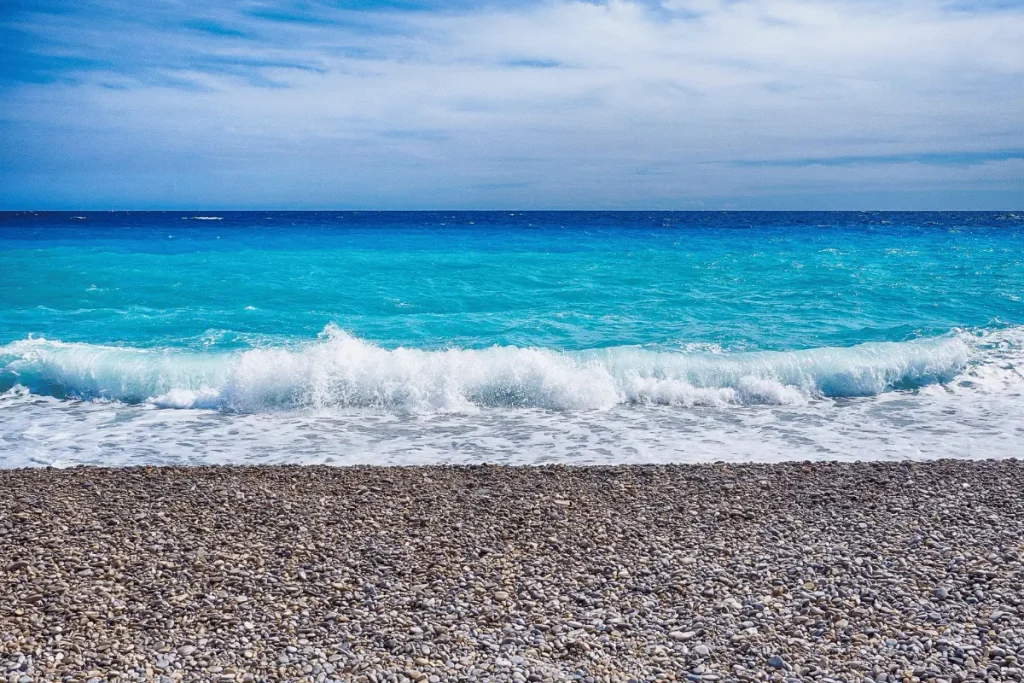
Vieux-Nice is a natural place to begin, with narrow streets and colorful façades leading toward the Cours Saleya market. The Promenade des Anglais follows the coast, while Castle Hill offers broad views over the old town, port, and Bay of Angels. France.fr highlights the city’s seven kilometers of pebble beaches and its position as a base for exploring the Riviera and surrounding areas. France.fr – Nice
One detail is easy to overlook when planning a beach-focused trip: Nice’s beaches are generally pebbly rather than sandy. That can affect both your expectations and what you pack.
Where to stay: Vieux-Nice is atmospheric and convenient for evening walks, while the area around Place Masséna gives you an easy middle ground between the old town, waterfront, shopping streets, and transport. Check the exact walking route from any hotel because the coastline stretches well beyond the historic center.
Top things to do in Nice
- Walk the Promenade des Anglais.
- Explore Vieux-Nice.
- Visit the Cours Saleya market.
- Go up Castle Hill for the views.
- Spend time around Place Masséna.
- Walk through the port district.
- Visit one of Nice’s art museums.
- Use Nice as a base for Riviera day trips.
Local tip
Wear footwear that works on both city streets and pebbly beaches. For Riviera day trips, check the last return train before heading out so you are not planning around a connection that does not suit your schedule.
Best for
Couples, French Riviera trips, coastal scenery, art, food, sunshine, and relaxed city breaks.
How many days to stay
Allow 3–4 days to enjoy Nice itself and leave room for one or two nearby excursions.
3. Lyon — A Food and Culture Capital
Why visit Lyon
Lyon suits travelers who want a major French city without the scale of Paris. The city sits where the Rhône and Saône meet and combines Roman heritage, Renaissance streets, traditional food, museums, river walks, and lively neighborhoods.
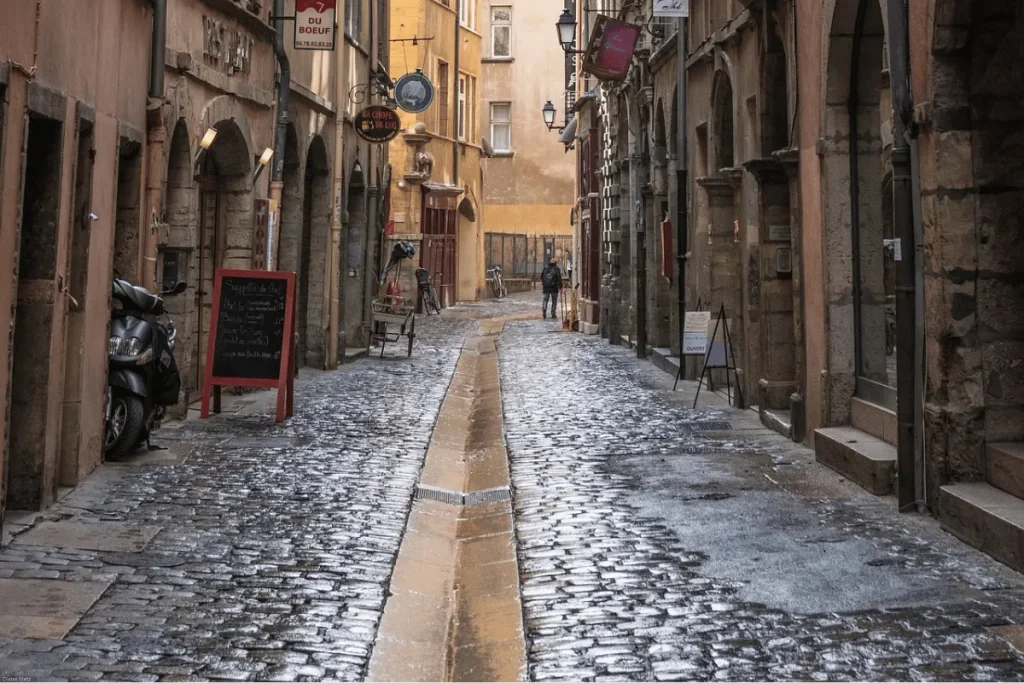
Vieux Lyon is especially rewarding on foot, with historic buildings and the famous traboules, passageways that connect streets through buildings. Lyon’s culinary identity is just as important. Traditional bouchons remain part of the city’s character, while the wider food scene gives travelers plenty of choice. France’s official tourism information also emphasizes Lyon’s heritage, architecture, cuisine, and historic neighborhoods. France.fr – Lyon
Lyon also fits naturally into a multi-city trip. Paris + Lyon creates a straightforward capital-and-culture combination, while Lyon + Marseille takes you toward Provence and the coast.
Where to stay: The Presqu’île puts many central sights, restaurants, and shopping streets within easy reach. Vieux Lyon is a better fit when the historic setting itself is part of the experience. Let your daily walking route help determine your hotel location.
Top things to do in Lyon
- Walk through Vieux Lyon.
- Discover the city’s historic traboules.
- Explore the Presqu’île.
- Visit Fourvière and enjoy the views.
- Try traditional Lyonnaise dishes.
- Explore the Musée des Confluences.
- Walk along the Rhône or Saône.
- Spend some time in the Croix-Rousse district.
Local tip
If food is a major part of your trip, reserve popular restaurants ahead of time and group Vieux Lyon, Fourvière, and the Presqu’île by area so you spend less time crossing the city.
Best for
Food lovers, history, architecture, culture, and travelers who enjoy walkable city breaks.
How many days to stay
Plan for 2–3 days. Food-focused travelers may prefer the longer end of that range.
4. Bordeaux — Wine, Architecture and Elegance
Why visit Bordeaux
Bordeaux suits travelers who want a polished city break built around food, architecture, riverfront walks, and access to famous wine country. The historic center is easy to combine with museums, restaurants, and time along the Garonne.
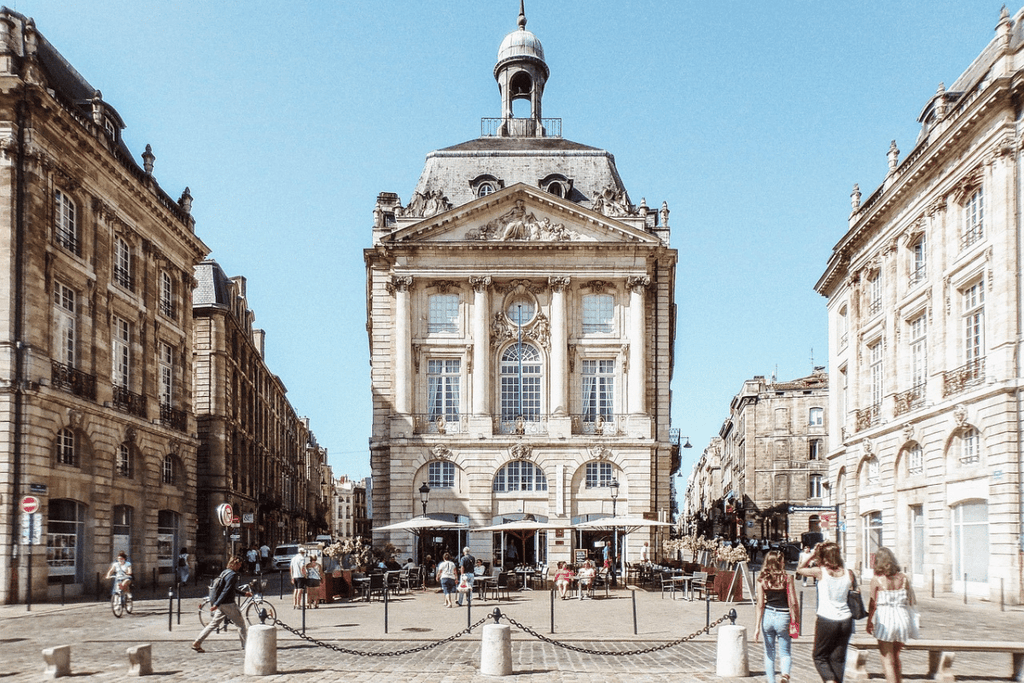
Place de la Bourse and the Miroir d’eau are among the city’s best-known sights, while the Cité du Vin provides a broader look at the cultural history of wine. Bordeaux Tourism & Congress provides current visitor information on the historic center, neighborhoods, wine experiences, transport, and local attractions. Bordeaux Tourism & Congress
The main planning choice is whether Bordeaux will be the destination itself or your base for exploring the surrounding region. A city-focused weekend can be comfortably paced, while vineyard excursions require more planning.
Where to stay: The historic center is convenient for first-time visitors. Chartrons is another option, particularly for travelers who want restaurants, cafés, and a neighborhood atmosphere. When booking accommodation for a wine-focused trip, check the meeting point and transport arrangements for your vineyard excursion.
Top things to do in Bordeaux
- See Place de la Bourse and the Miroir d’eau.
- Walk beside the Garonne.
- Visit the Cité du Vin.
- Explore the historic center.
- Enjoy Bordeaux’s restaurants and cafés.
- Plan a vineyard excursion.
- Add an Atlantic coast day trip when your schedule allows.
Booking tip
If wine tasting is one of the main reasons for visiting, organize the vineyard experience before filling the rest of the itinerary. The timing and transport can determine how much time you actually have in the city.
Best for
Wine lovers, food lovers, architecture, couples, and elegant weekend breaks.
How many days to stay
Allow 2–3 days for Bordeaux itself, with additional time when vineyard excursions are an important part of the trip.
5. Marseille — Mediterranean France
Why visit Marseille
Marseille shows a rougher, more Mediterranean side of France. It is a major port city with more than two millennia of history, diverse neighborhoods, strong Provençal influences, and access to dramatic coastal landscapes.
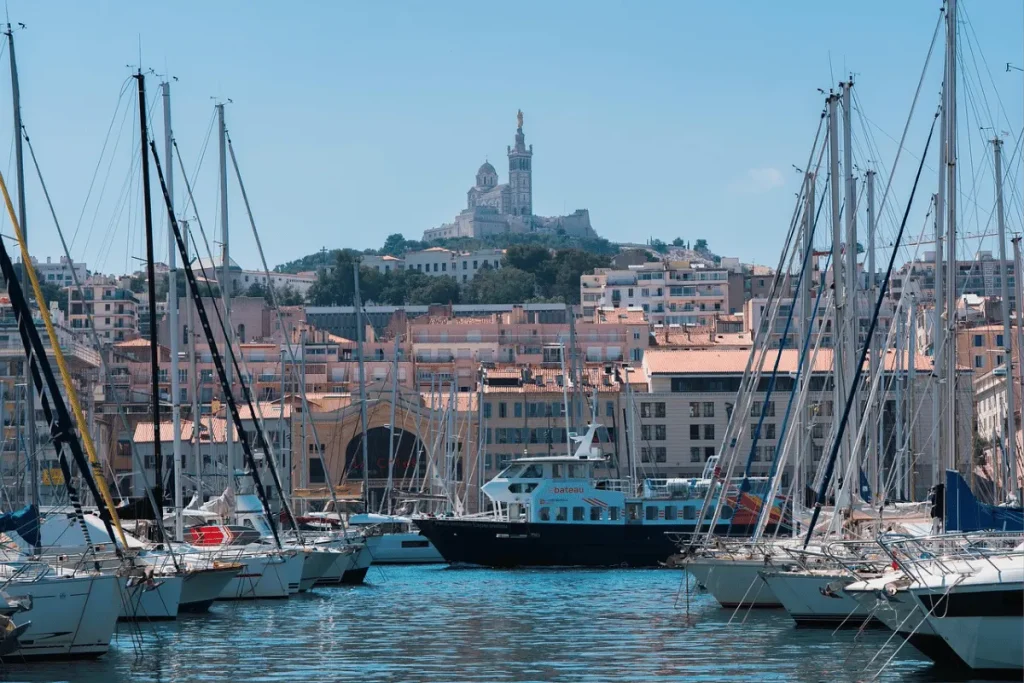
The Vieux-Port is the natural starting point, while Le Panier provides historic lanes and a different pace. The MuCEM adds a major cultural stop, and the nearby Calanques National Park brings spectacular scenery outside the urban core. France.fr also highlights the Vieux-Port, Le Panier, MuCEM, and the Calanques. France.fr – Marseille
Marseille rewards travelers who leave room for both the city and the coast. If the Calanques are a priority, check access conditions and transportation options before finalizing your plans because access can vary with weather and seasonal conditions.
Where to stay: The Vieux-Port area is convenient for a first city-focused visit. Travelers who expect to spend most of their time hiking or visiting coastal sites should compare transportation times before choosing a hotel.
Top things to do in Marseille
- Explore the Vieux-Port.
- Wander through Le Panier.
- Visit the MuCEM.
- See Notre-Dame de la Garde.
- Explore the waterfront and local markets.
- Plan time in or around the Calanques.
- Try Provençal and coastal specialties.
Before the coast
Treat the Calanques as a separate planning block. Check official access conditions close to your travel date, especially during periods of high heat or increased fire risk.
Best for
Coastal travel, scenery, history, food, culture, and outdoor experiences.
How many days to stay
Plan for 2–3 days, or longer when you want to dedicate substantial time to the Calanques and nearby Provence.
6. Strasbourg — History and European Culture
Why visit Strasbourg
Strasbourg stands out among French city breaks because its identity is strongly shaped by Alsace. The historic center combines Gothic architecture, canals, half-timbered houses, elegant squares, and regional food traditions.
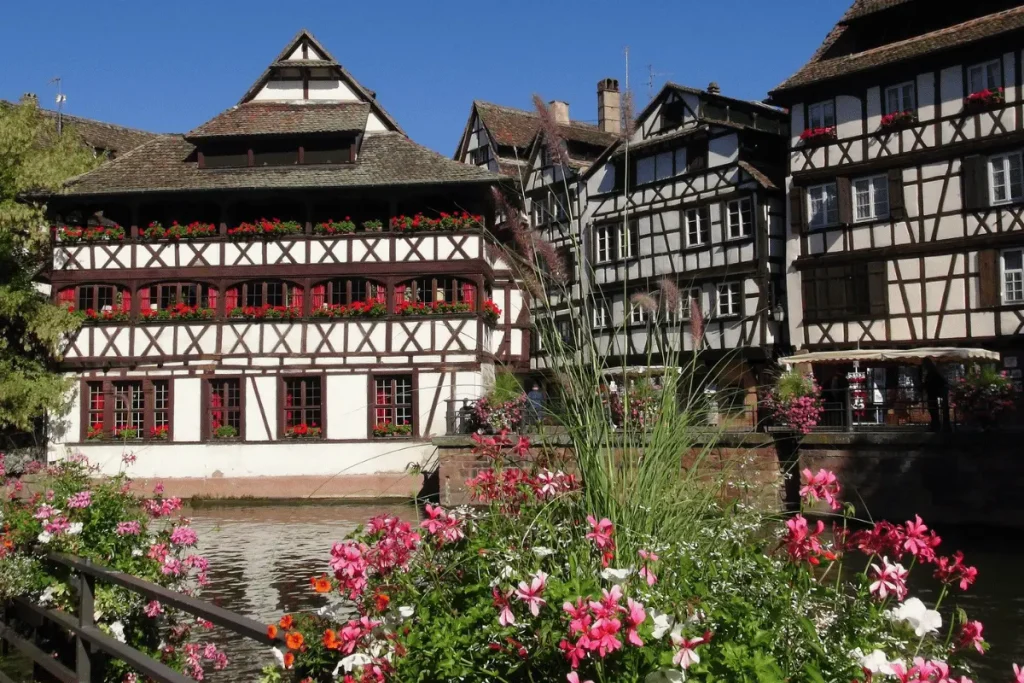
The Grande Île is a UNESCO World Heritage Site, while Petite France is known for its canals and historic buildings. Strasbourg Cathedral is another major landmark, and the city’s Alsatian identity comes through in its architecture, food, and traditional neighborhoods. France.fr also highlights Strasbourg as an important cultural and romantic destination. France.fr – Strasbourg
Strasbourg is particularly easy to enjoy over a short stay because the historic core is compact and well suited to walking. With additional time, the city can also serve as a base for exploring other parts of Alsace.
Where to stay: Staying on or near the Grande Île keeps the Cathedral, Petite France, restaurants, and much of the evening atmosphere close by. When choosing a hotel outside the center, check tram access as well as the walking distance to the sights you want to see.
Top things to do in Strasbourg
- Visit Strasbourg Cathedral.
- Walk through Petite France.
- Explore the Grande Île.
- Take a boat trip along the canals.
- Try traditional Alsatian food.
- Visit the city’s museums.
- Add an Alsace day trip to your itinerary.
Local tip
Start around Petite France earlier in the day if you want quieter streets and easier photo stops before the busiest sightseeing period.
Best for
History, architecture, couples, regional food, Christmas markets, and cultural travel.
How many days to stay
Plan for 2 days in Strasbourg, or longer if you are adding excursions through Alsace.
7. Toulouse — The Pink City
Why visit Toulouse
Toulouse offers a relaxed introduction to southwestern France. Its nickname, the Pink City, comes from the warm tones of its brick architecture, which are especially noticeable around the historic center.
Place du Capitole is the city’s focal point, while the Garonne and Canal du Midi provide space for slower walks. Toulouse also has a strong connection to aerospace and science through attractions such as the Cité de l’Espace. France.fr highlights these experiences, giving travelers a mix of historic, outdoor, and aerospace-focused reasons to include Toulouse in a wider southwestern itinerary. France.fr – Toulouse
Where to stay: Capitole is an obvious choice for a first stay, while Carmes offers another central base with restaurants and historic streets nearby. If you are planning regional day trips, compare the hotel location with the railway station you expect to use.
Top things to do in Toulouse
- Explore Place du Capitole.
- Walk along the Garonne.
- Visit the Basilica of Saint-Sernin.
- Explore the historic center.
- Walk or cycle near the Canal du Midi.
- Visit the Cité de l’Espace.
- Try southwestern French specialties.
Planning tip
If the Cité de l’Espace or Canal du Midi is a major part of your itinerary, check opening times and travel time from the city center before setting your daily route.
Best for
Local culture, food, history, architecture, relaxed city breaks, and southwestern France.
How many days to stay
Allow 2–3 days.
8. Lille — A Different Side of France
Why visit Lille
Lille suits travelers who want to see a version of France that feels distinctly northern. Close to Belgium, the city has a strong regional character, with Vieux Lille’s cobbled streets, brick and stone façades, independent shops, and cafés setting the tone.
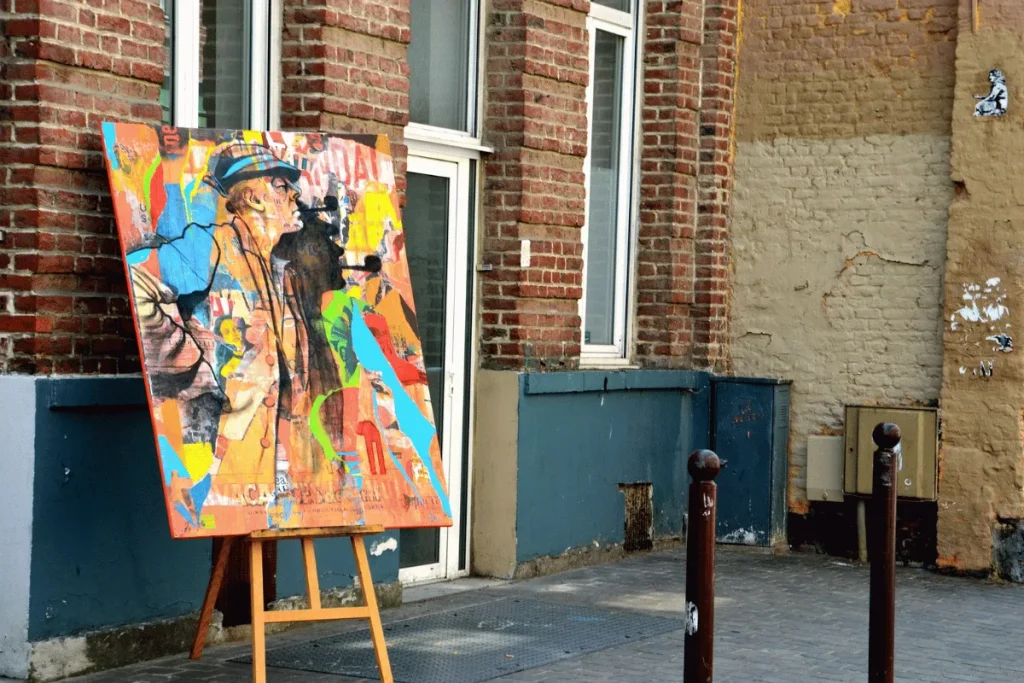
The Grand’Place and Palais des Beaux-Arts add major cultural stops, while local specialties and traditional estaminets give the city a clear northern identity.
Lille is well suited to a weekend because Vieux Lille, Grand’Place, and the Palais des Beaux-Arts can be combined into a compact itinerary. France.fr also highlights the city’s architectural heritage, cultural attractions, and regional food traditions. France.fr – Lille
Where to stay: Vieux Lille is the most atmospheric base, while the wider city center is practical for rail connections. For a short weekend, a walkable hotel location can save more time than choosing a cheaper property farther away.
Top things to do in Lille
- Explore Vieux Lille.
- Visit the Grand’Place.
- See the Palais des Beaux-Arts.
- Walk through the historic streets.
- Try northern French specialties.
- Eat in a traditional estaminet.
- Explore local markets and cafés.
Planning tip
For a two-day visit, stay close enough to Vieux Lille or the city center that Grand’Place, the Vieille Bourse, and the Palais des Beaux-Arts can be covered without unnecessary transfers.
Best for
Weekend trips, food lovers, architecture, culture, and travelers looking for a different side of France.
How many days to stay
Plan for 2 days.
9. Aix-en-Provence — The Heart of Provence
Why visit Aix-en-Provence
Aix-en-Provence is a city where atmosphere matters as much as the landmark list. Fountains, plane trees, small squares, cafés, markets, elegant architecture, and Provençal daily life make it a natural fit for slower itineraries.
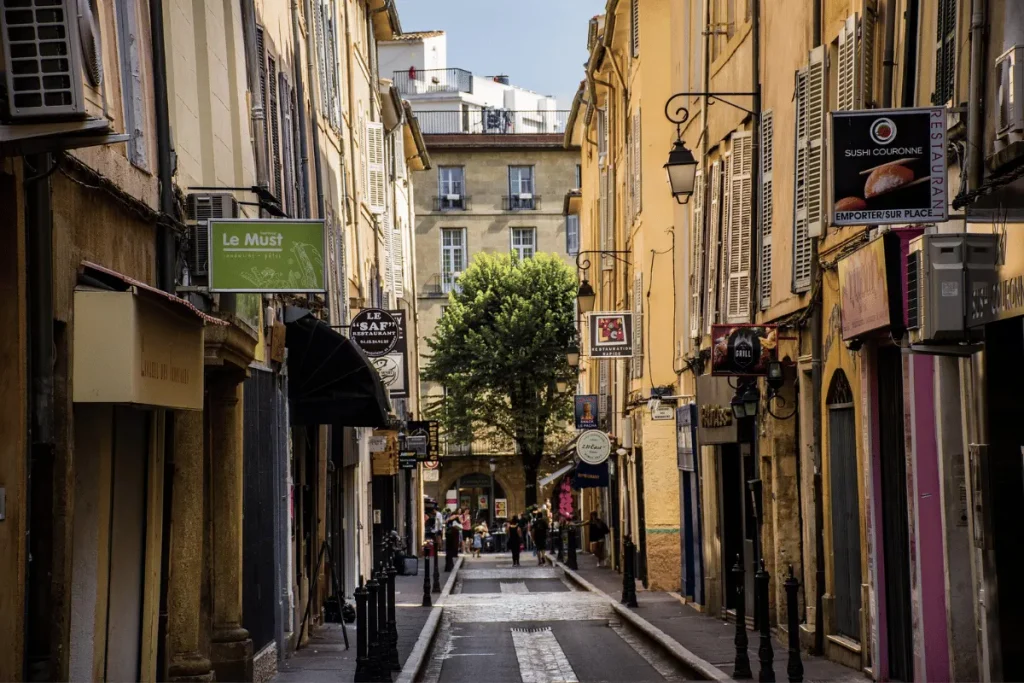
Cours Mirabeau is the most recognizable starting point, and the city has a deep connection to Paul Cézanne. The Aix-en-Provence tourism office provides information about Cézanne-related sites and experiences, including places connected with the artist. Aix-en-Provence Tourism Office
Aix fits naturally into a wider Provence trip. Instead of trying to fill every hour with attractions, leave time for a market, a long lunch, and a walk through the historic center.
Where to stay: The historic center is the easiest base for a car-free city break. When Provence day trips are the priority, compare the convenience of central parking with properties farther out if you are renting a car.
Top things to do in Aix-en-Provence
- Walk along Cours Mirabeau.
- Explore the historic center.
- Visit local markets.
- Follow Cézanne-related sites.
- Visit the Musée Granet.
- Enjoy cafés and Provençal cuisine.
- Use Aix as a base for exploring Provence.
Planning tip
Check the market schedule for your travel dates, then group Cours Mirabeau, the historic center, and Cézanne-related stops into the same day before using another day for Provence excursions.
Best for
Provence, art, couples, markets, food, and slower city breaks.
How many days to stay
Allow 2 days, with extra time for Provence day trips.
10. Montpellier — Sun, Culture and the Coast
Why visit Montpellier
Montpellier combines a historic center with a younger, energetic atmosphere. The city is close to the Mediterranean coast and offers a mix of architecture, museums, cafés, markets, contemporary culture, and access to the surrounding vineyards.
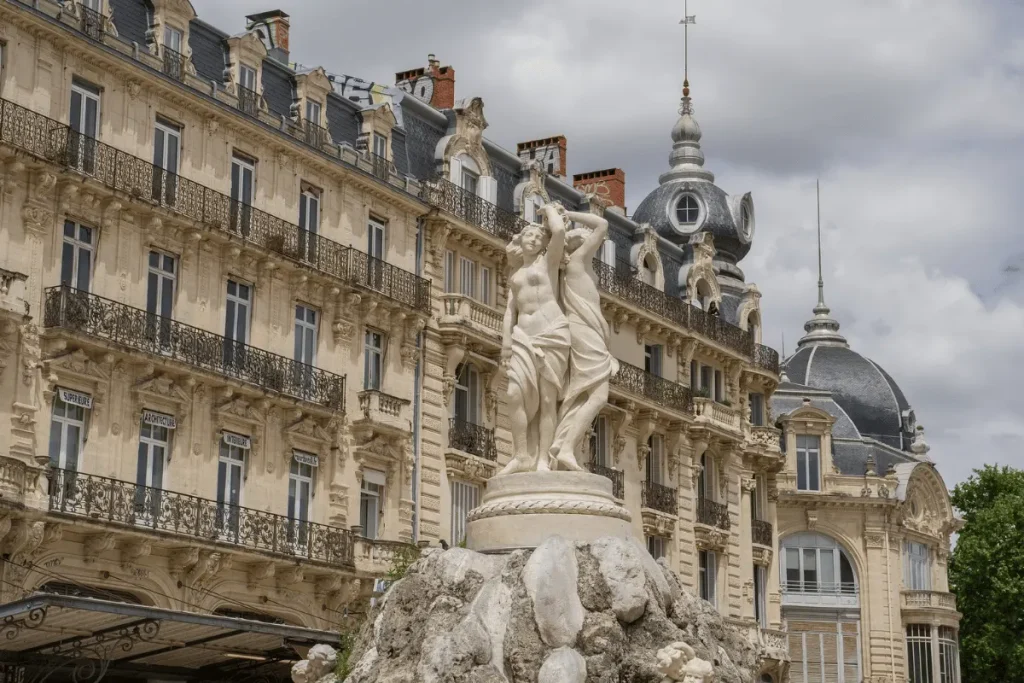
The Écusson historic district is ideal for walking, while Place de la Comédie is the natural central meeting point. France.fr highlights Montpellier’s proximity to the Mediterranean, vineyards, and surrounding Hérault landscapes. France.fr – Montpellier
One distinction matters when choosing Montpellier: it is near the beach rather than directly on the seafront. That can be an advantage when you want both city culture and coastal access, but a beach-first trip may be better suited to staying closer to the coast.
Where to stay: The Écusson works well for a city-focused trip. If beaches are the main reason for choosing Montpellier, compare the additional journey time to the coast before assuming the city center is the most convenient base.
Top things to do in Montpellier
- Explore the Écusson historic center.
- Visit Place de la Comédie.
- Discover the Musée Fabre.
- Walk through the Promenade du Peyrou, also known as Place Royale du Peyrou.
- Explore local markets.
- Visit nearby Mediterranean beaches.
- Discover vineyards around Montpellier.
Coast tip
For a beach day, check return transportation before leaving the city center. Montpellier’s main attractions are urban, while the coast is nearby rather than directly in town.
Best for
Sun, culture, nearby beaches, wine, younger energy, and a southern French lifestyle.
How many days to stay
Plan for 2–3 days.
How to Choose the Best City in France for Your Trip
There is no single city that fits every itinerary. The easiest way to decide is to start with the experience you want, then check whether the city’s location and ideal trip length fit your schedule.
Best City in France for First-Time Visitors
Paris is the most straightforward starting point for a first trip because it combines major landmarks, museums, historic neighborhoods, food, architecture, and culture in one place.
That does not mean you need to spend your entire vacation in Paris. With a week or more, pairing Paris with one contrasting city can give you a broader view of France without turning the trip into a series of hotel changes.
Best French Cities for Couples
Nice, Aix-en-Provence, Paris, Bordeaux, and Strasbourg offer different styles of romantic travel.
Nice is built around the waterfront, Riviera scenery, and outdoor time. Aix has a slower pace with cafés, fountains, markets, and Provence nearby. Bordeaux adds riverside walks, grand architecture, restaurants, and wine-country excursions. Strasbourg brings canals, historic buildings, and Alsatian atmosphere, while Paris offers museums, neighborhoods, restaurants, and evening walks.
For a couples-focused itinerary, Paris + Nice creates a clear contrast between major-city sightseeing and the Riviera. Paris + Bordeaux works well for travelers who want architecture, restaurants, and a wine-country day trip.
For more romantic trip ideas, explore our guide to Best Travel Destinations for Couples in France.
Best Cities in France for Food Lovers
Lyon is one of the clearest choices for travelers building a trip around French gastronomy, but Bordeaux, Toulouse, Marseille, Strasbourg, Lille, and Paris all bring distinctive culinary traditions.
The useful question is not simply which city has good food, but what kind of food experience you want. Lyon is associated with traditional bouchons and a deep culinary culture. Bordeaux pairs gastronomy with wine. Marseille brings Provençal and coastal flavors. Strasbourg adds Alsatian specialties, while Lille reflects northern French and Flemish culinary influences.
Best French Cities for Beaches
For a city-and-coast trip, Nice and Marseille provide two of the most direct combinations on this list.
Nice puts the waterfront at the center of the city, while Marseille combines urban sightseeing with access to the dramatic coastline around the Calanques.
Montpellier is another option when you want a city base with Mediterranean beaches within reach rather than a hotel directly on the shore.
Best Cities in France for History and Culture
Paris, Lyon, Strasbourg, Bordeaux, and Aix-en-Provence each offer a strong combination of historic places, architecture, museums, and regional identity.
Paris has the broadest concentration of major museums and landmarks. Lyon brings Roman and Renaissance layers. Strasbourg highlights Alsatian heritage and architecture. Bordeaux is known for its grand historic center, while Aix connects urban life with Provençal history and Cézanne.
Planning Your Trip to France
Once you have chosen the cities, the next decisions are how many bases to use, how to connect them, and which season fits your plans.
How Many Days Do You Need to Visit France?
There is no universal answer, but the length of your trip should determine how ambitious your route becomes.
3–4 days
Choose one main city.
Paris, Nice, Lyon, Bordeaux, Strasbourg, or another city can work well when you want to avoid rushing between destinations.
5–7 days
Choose two cities that are relatively easy to connect.
For example:
Paris + Lyon — a classic combination of major sights, food, and history.
Paris + Strasbourg — famous landmarks followed by a distinctly Alsatian setting.
Paris + Bordeaux — city sightseeing paired with wine country.
Paris + Nice — capital-city highlights followed by the Riviera.
8–10 days
A longer trip gives you room for a multi-city itinerary, but it is still worth limiting hotel changes.
One possible route is:
Paris → Lyon → Marseille → Nice
Another option is:
Paris → Bordeaux → Toulouse
The key is to consider all the time around a journey, not only the train ride. Checking out of a hotel, getting to the station, waiting for the train, arriving in a new city, and finding your accommodation can consume part of a sightseeing day.
How to Travel Between French Cities
Trains are often the easiest way to connect major French cities, especially on routes served by TGV services. SNCF Connect currently lists direct services between Paris and many of the cities covered in this guide. The journey times below are useful planning references, but they vary by date, service, and station.
- Paris → Lyon: allow roughly 2 hours to Lyon Part-Dieu on a direct high-speed service. SNCF Connect also lists a faster 1h 43m Paris–Lyon journey among its services, but that should not be treated as the standard planning time for every trip to Part-Dieu. SNCF Connect – Paris to Lyon
- Paris → Bordeaux: the fastest listed journey is about 2h 02m on a direct service. SNCF Connect – Paris to Bordeaux
- Paris → Marseille: the fastest listed journey is about 3h 04m on a direct high-speed service. SNCF Connect – Paris to Marseille
- Paris → Strasbourg: the fastest listed journey is about 1h 44m on a direct service. SNCF Connect – Paris to Strasbourg
- Paris → Nice: the fastest listed journey is about 5h 42m, with direct services available. SNCF Connect – Paris to Nice
These are planning reference points rather than guaranteed travel times. Always check the live timetable and fare for your exact travel date before booking.
For regional travel around Provence, the Riviera, or the countryside, a rental car can sometimes be more practical, particularly when several villages or rural attractions are involved. In the major cities themselves, however, a central hotel and public transportation may make a car unnecessary.
When Is the Best Time to Visit France?
France works as a year-round destination, but the best time depends on the cities and experiences on your itinerary.
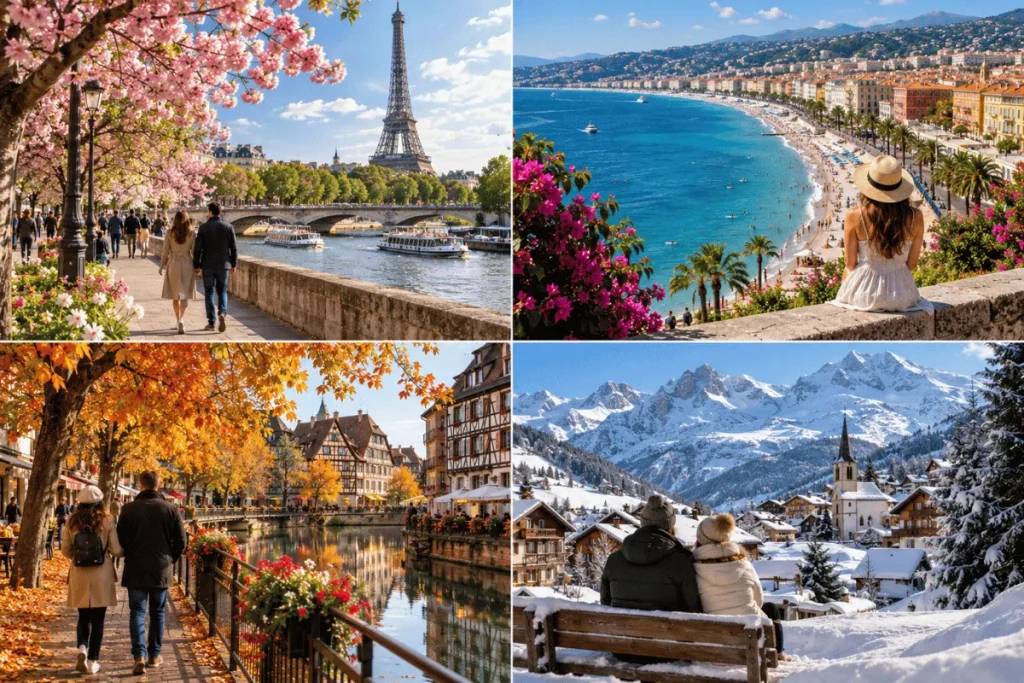
Spring
Spring, particularly April through May, is well suited to walking tours, gardens, museums, city breaks, and travelers who prefer exploring before the peak summer period.
It is also a useful season for combining city sightseeing with outdoor activities without building the entire trip around beach weather.
Summer
June through August is the main season for Mediterranean beach time. Nice, Marseille, and Montpellier are natural choices for travelers who want to combine city sightseeing with the coast.
The trade-off is that popular destinations can become much busier during the peak summer months, so accommodation and transport planning become more important.
Fall
September through October can work particularly well for food-focused trips, wine regions, photography, and city exploration.
Bordeaux is a natural candidate when vineyard experiences are central to the itinerary, while cities such as Paris, Lyon, and Strasbourg can also be comfortable bases for cultural trips.
Winter
November through February changes the feel of French cities. Paris remains attractive for museums, restaurants, cafés, and indoor attractions, while Strasbourg becomes a major seasonal destination around its Christmas market period.
Rather than choosing a city based on season alone, match the timing to the experience you want: coast in warmer weather, city culture in cooler months, and regional food or wine when those activities are central to the trip.
Frequently Asked Questions About French Cities
What Are the Best Cities to Visit in France?
Some of the most useful cities to consider for a varied France itinerary are Paris, Nice, Lyon, Bordeaux, Marseille, Strasbourg, Toulouse, Lille, Aix-en-Provence, and Montpellier.
The right choice depends on your priorities. Paris offers a broad introduction to France, Nice suits the French Riviera, Lyon is especially strong for food and culture, Bordeaux combines architecture with wine country, Marseille provides access to the coast and Calanques, Strasbourg offers Alsatian heritage, and the remaining cities add different regional experiences.
France’s official tourism platform also provides current destination information for cities across the country. France.fr
What Are the Best Cities to Visit in France Besides Paris?
Good alternatives include Nice, Lyon, Bordeaux, Marseille, Strasbourg, Toulouse, Lille, Aix-en-Provence, and Montpellier.
Choose among them according to the type of trip you want. Nice works for the Riviera and coast, Lyon for food and culture, Bordeaux for wine and architecture, Marseille for coastal scenery, and Strasbourg for a distinctly Alsatian city experience.
What Is the Best City to Visit in France for a First Trip?
Paris is the most straightforward starting point because it offers a broad mix of landmarks, museums, architecture, history, food, and neighborhoods.
For a longer vacation, adding one contrasting city can make the trip feel much more varied without creating a complicated route. Paris paired with Lyon, Strasbourg, Bordeaux, or Nice creates very different experiences depending on your interests.
How Many Cities Can You Visit in France in One Week?
For most travelers, two cities is a comfortable target for one week. Three cities can work when the connections are convenient and you are comfortable with a faster pace.
For example, Paris and Lyon can make a manageable combination, while Paris, Bordeaux, and Toulouse require more attention to transport and hotel changes.
A practical approach is to give each base enough time to experience its neighborhoods and main attractions rather than turning every stop into another hotel check-in.
Final Thoughts
The best cities to visit in France cover very different travel styles. Paris concentrates major landmarks and museums, Nice combines a walkable historic center with the waterfront and wider Riviera, Lyon is closely tied to food and history, Bordeaux connects city sightseeing with wine country, and Marseille opens the door to the Calanques and Provençal coast.
Strasbourg, Toulouse, Lille, Aix-en-Provence, and Montpellier add regional character that can change the pace of a longer itinerary. For most travelers, a practical next step is to choose one major city and one contrasting destination, then compare accommodation areas, rail connections, and day-trip options before filling the remaining days with activities.
Editorial & Source Note
This article was reviewed on September 19, 2026. Official tourism and rail sources are linked where they support specific destination or planning information. Train times, attraction access, opening hours, seasonal restrictions, and accommodation availability can change, so check the relevant official provider for your travel dates before booking.